
Structural Behaviour under static loads
Structural ability to withstand higher loads under static conditions & lifting loads.
In this blog we covered salient points of structural member behaviour under static load & lifting conditions and its effect on structural stability /survivability.
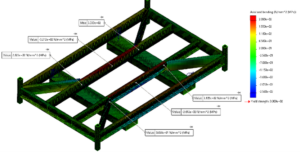
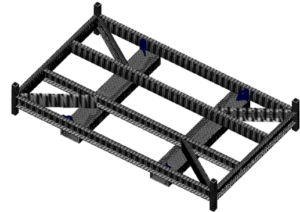
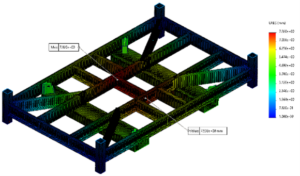
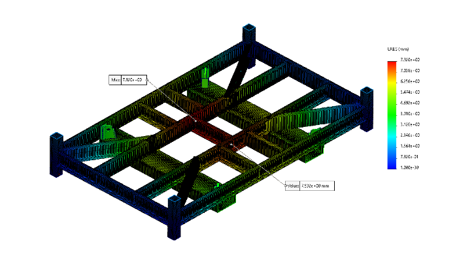
In any engineering project, the verification of load-bearing members is not just a regulatory requirement but a critical step in ensuring operational safety and preventing costly failures. For our recent project, the structural members were designed to support heavy equipment, safe for operation both under static load/dead load conditions and the loads that the structure must withstand during lifting conditions.
To ensure the selected I-beam and rectangular beam sections could withstand the applied loads while maintaining an adequate Factor of Safety (FoS), without any overdesign, but in compliance with various covenant standards and codes. To demonstrate the adequacy and compliance, a two-step validation was implemented.
- Empirical calculation.
We begin with traditional hand calculations/calculations from first principles to evaluate various stresses in the selected structural sections. The bending stress, shear stress, and equivalent stress are evaluated, and either the given structures are evaluated for suitability or structural member minimum sizing is arrived at by comparing the stresses against the allowable limits of the material as per general engineering standards and applicable/ governing standards. This ensures that the structural members are fundamentally safe and are capable of carrying the applied load
2. Simulation-Based validation.
We validated the results of stress and strain/ deflection for the given loads through Finite Element Analysis (FEA) using SOLIDWORKS Simulation. In this step, loads and boundary conditions are applied to the beam model, which is then meshed and analysed. The simulation provides a real-time understanding of how the structural member behaves under loading, showing detailed distributions of stress, strain, and displacement.
By combining these two methods (empirical validation and simulation), we adequately demonstrate and assure that the structural members can indeed withstand operational loads with the required safety margins.
At CM Techno, we specialize in static structural analysis using advanced CAE techniques, enabling us to design and verify rugged, reliable structures that meet the most demanding operational requirements without any overdesign, thus bringing an economical solution.
For details email enquiy@cmtechno.in and services@cmtechno.in
(or)
Mr. Praveen Chandra; +91 8884411860 Email: praveen.c@cmtechno.in